
Introduction
When the drama Big Businessman aired in late 2025, Xiang Hanzhi’s portrayal of Bai Yimei sparked an unexpected firestorm. A woman of scholarly background navigating a turbulent era, she practices medicine, wears simple robes and a cyan hairpin, a few loose strands of hair framing her face. One glance over her shoulder amid the smoke of war was enough to send her trending. Her strength doesn’t come from a sword or from scheming; it comes from an aura of “cool fragility, gentle resilience.” When Li Cheng, the general of the Righteous Vanguard Army, mutters, “The Bodhisattva won’t save me,” Bai Yimei kneels in tears, presses her palms together, and replies, “I will.” She repeats that phrase three times—her voice soft yet threaded with steel. Xiang Hanzhi’s own note on the character is beautifully precise: “She’s as slender as a strand of hair, but that strand is steel wire—gentle on the outside, resilient at heart, almost impossible to break.”
Her popularity, however, wasn’t without pushback. Some viewers argued that the writers, determined to turn Li Cheng and Bai Yimei into a couple, forced the character dynamics in unconvincing ways. One critique went so far as to say, “If they’d written Bai Yimei as a villain, audiences might have accepted it, but the show insisted on molding her into a modern woman who dares to love and hate, who boldly pursues romance—it just doesn’t ring true.” Yet the controversy itself signals a meaningful shift: Chinese audiences’ understanding of female power is going through a profound evolution. A female character viewers adore doesn’t have to shatter tradition; she can be gentle. As Xiang Hanzhi’s performance shows, her character comes from an ordinary background that is never mediocre, and the way she handles things makes you think, “Of course she would do that.”
On the other end of the screen, however, the picture couldn’t be more different. In Chasing Jade, Fan Changyu, originally a proudly confident pig-slaughtering girl, is turned into an illiterate ashamed of her trade. In Flourishing Beauty, the female lead He Weifang gets slammed by viewers for “constantly preaching female independence, yet relying on the male lead for literally everything.” A string of female general dramas—Song of the Splendid Moon, With Jin Chang’an, A Smile Follows the Song, Mountain and River Pillow—served up a rare four-flop streak, averaging a measly 5.55 on Douban, prompting the cry, “Please, Chinese entertainment industry, just leave female generals alone!” On one side, audience tastes are maturing and diversifying; on the other, the writing feels thin and regressive. When “female-centered” TV dramas are blooming everywhere, why has the portrayal of women fallen into such a homogenized dead end? Behind this lies a tangled knot: the evolution of Chinese audiences’ feminist consciousness, the path dependency of industrialized screenwriting, and the erosion of women’s stories by the logic of traffic and views.
I. From Hating Pink to Loving Pink: The Three-Stage Evolution of Feminist Consciousness
To understand the current paradox, we need to trace the journey of audience tastes.
Stage One: The Allure of Power and Authority (c. 2015–2020)
Roughly between 2015 and 2020, the core narrative formula of “big female lead” dramas was strikingly uniform: the heroine had to grab power, be ruthless and decisive, and claw her way to the top in a man’s world. The harem intrigue of Empresses in the Palace, the battlefields of Princess Agents, the business empire building of Nothing Gold Can Stay—all revolved around the appeal of “she’s tougher than the men.” At this stage, the expression of female power was essentially an appropriation of a masculine framework: the female character had to defeat male rivals to prove her worth, and her appeal was reduced to “doing what men can do.” Traditional TV and film had long pushed the ideology of women being confined to the home, saddled with heavy reproductive and domestic labor yet denied real public power. The big female lead drama disrupted this narrative, spotlighting women’s efforts to break free and build their own subjectivity. Yet this early “disruption” still measured women against a male yardstick—women had to become “as strong as men” for their value to count.
Stage Two: Rejecting Traditional Femininity (c. 2021–2023)
As fourth-wave feminist ideas spread globally, “pink equals weak” and “gentle equals compromise” became a kind of collective subconscious for a time. Screens flooded with deliberately “de-gendered” female characters, as if the only way to signal progress was to reject traditional femininity. Of the dozen-plus costume big female lead dramas that dropped in 2025, nearly every heroine was stamped with the labels of independence and clear-headedness, scorning romance and challenging norms, their dialogue as radical as a contemporary feminist manifesto. But a progressive narrative built on negation contains a built-in paradox: if female power only becomes legitimate by rejecting femininity, then it just reinforces the supposed “crime” of femininity itself.
Another hallmark of this stage was the industrialized cloning of themes. So many female-skewing shows rehashed plots about cheating husbands and older women clawing their way back to the office, reducing women’s issues to clichés, while real, down-to-earth women’s lives got pushed aside. The 2.0-era hits, like Ode to Joy and Nothing But Thirty, packaged women’s struggles inside a cushy cocoon of elite privilege—screenwriters twisted themselves into knots trying to manufacture modern women’s dilemmas and awakenings, but the result felt completely out of touch. That sense of detachment was a sign that audience tastes were about to shift.
Stage Three: The Pluralist Return, Loving Pink Again (Now)
We’re in the middle of that shift right now. The key evolution can be summed up like this: women’s awakening goes from “loving pink” to “hating pink,” then to “loving pink again.” The central idea is simple: equality isn’t about trashing all traditions; it’s about affirming a woman’s right to choose for herself. Whether she chooses career or family, toughness or softness, each should be equally respected. Female images shouldn’t be rigidly defined, nor trapped by class; society should give women more choices and more possibilities.
Bai Yimei has become a touchstone of this shift precisely because she is neither a Mulan figure nor a lovesick fool. She lives as an irreplaceable presence in a chaotic world on her own terms—through medicine, compassion, and quiet resilience. The crackling contrast between her and Li Cheng—the rough warrior and the healer—pushed the “Big Bad Wolf and Little White Rabbit” CP to the top of the trending lists, with viewers saying, “This love blooming in blood and fire is so angsty, yet so addictive to ship.” When Li Cheng, mocking his blood-soaked hands, says he’s “bound for hell,” Bai Yimei’s gaze shifts from pity to resolve as she holds out the medicine she’s just brewed. Her three “I will”s build in intensity—first, a soft echo: “If the Bodhisattva won’t save you, I will.” Then, eyes lifted: “The hell you’re afraid of, I’ll walk with you.” Finally, gripping the spoon: “The lives you owe, I’ll spend this lifetime repaying.” That right to choose is another form of strength.
This shift isn’t happening in a vacuum. Globally, Gen Z-driven “fifth-wave feminism” is rewriting the rules, summed up as “the collision of hyper-femininity and systemic critique”—young women are refusing to choose between Barbie and Oppenheimer; they’re choosing both. That refusal of binary thinking echoes, across cultures, what Chinese audiences now want from female characters. And in Chinese TV’s creative sphere, 2026 has shown encouraging signals: women’s storytelling is moving from “big female lead” to “female-centered”—no longer crafting flawless women or chasing a power-trip high, but focusing instead on women’s real circumstances, inner turmoil, and value choices.
II. Paper Dolls Shouting Slogans: The Creative Dead End
Yet while audience aesthetics have marched through three stages, the writing has barely budged, sinking deeper into the assembly-line quagmire.
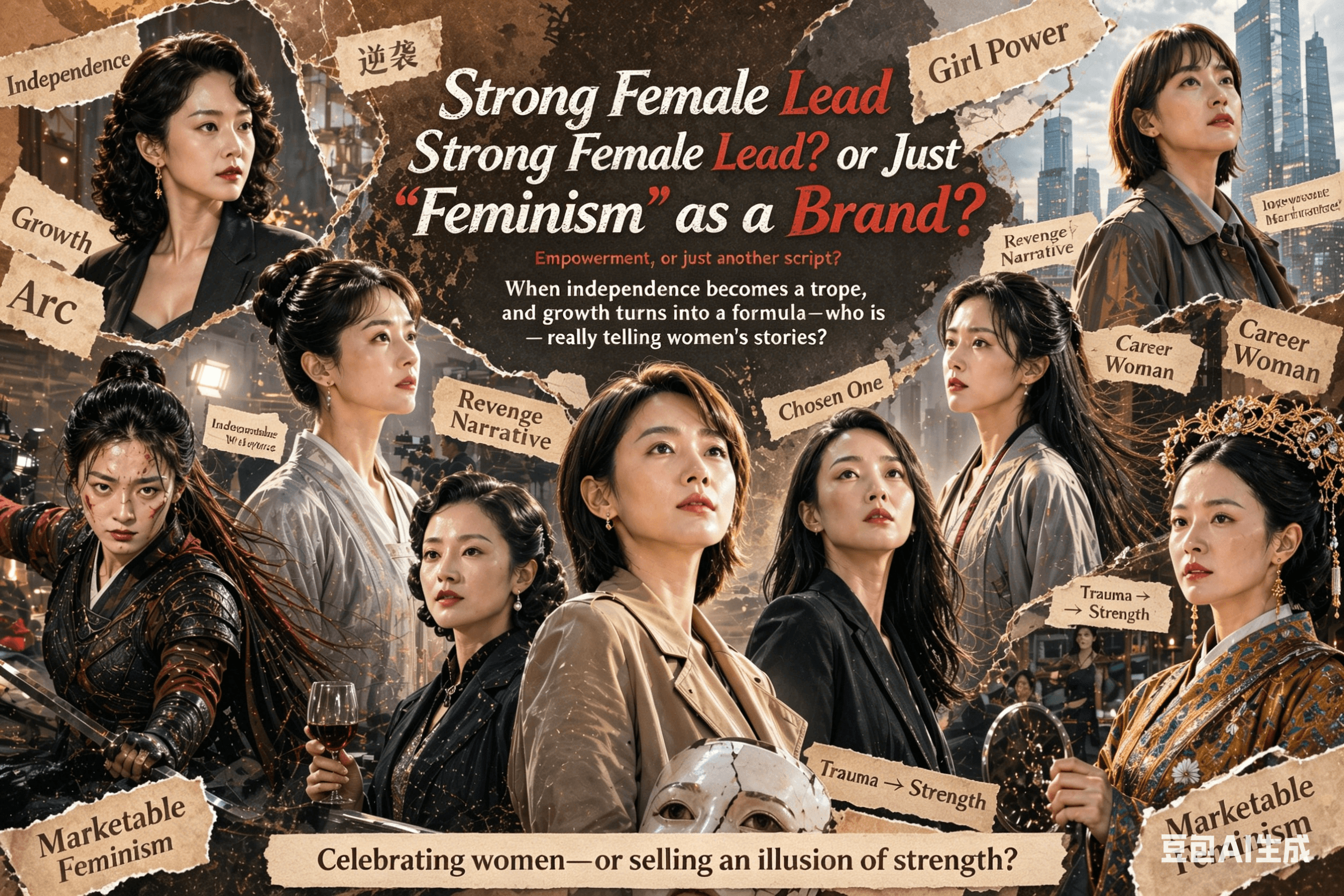
Today’s Chinese “big female lead” dramas are stuck in a bizarre loop: the dialogue screams female independence, but the plot keeps falling back on a man to save the day. This “disconnect between declarations and actions” shows that creators see women’s issues as a trend to jump on, not a value to internalize. Many female-centric dramas have stumbled into the industrialization trap, trying to pander with formulaic “girl power” plots that just harden clichés. The characterization serves the drama, not true expression, pulling the genre loose from real life and cheapening what “her power” is supposed to mean.
Chasing Jade: A Big Female Lead Systematically Stripped of Power
Chasing Jade premiered in March 2026. In the source novel, Tian Xiwei’s Fan Changyu is a pig-slaughtering girl who takes fierce pride in her craft and feels zero shame—her iconic line “I slaughter pigs to support you” gained her legendary status. But the drama adaptation whittles this vivid character down, layer by layer. Under screenwriter Zou Yue’s hand, Fan Changyu keeps “hiding her knife” around the male lead Xie Zheng, consumed by insecurity and terrified of being looked down on. The novel’s literate girl is rewritten as illiterate, while the male lead gets saddled with all-around superiority—martial arts, calligraphy, elite birth—creating a suffocating power imbalance. Every time the heroine hits a wall, the solution isn’t her own wits; it’s the male lead’s repeated deus ex machina rescue.
By March 2026, the adaptation controversy had boiled over. Early on, audiences lashed out at the show for, on one hand, trying to wave the flag of feminist consciousness with anti-period-shame messaging, while on the other, piling on regressive tropes—the heroine’s professional shame, female characters ripping each other apart with chastity checks and sexual gossip. Viewers bluntly called it “trash taste.” Later, both leads’ arcs went muddled: Fan Changyu’s big battlefield moment, which should have been cathartic, gutted her heroic aura with fractured logic, and Xie Zheng’s supposed martial prowess kept collapsing to the point of mockery.
Even more jarring was the heroine’s emotional whiplash—one second she’s ashamed to call herself a pig-slaughtering girl, the next she’s chest-out declaring herself “the number one butcher of Lin’an Town,” the shift as abrupt as a marionette with its strings cut. The root of why this rings so false is that the novel’s core was Fan Changyu’s defiance of male economic dominance—her pride in her trade. The adaptation not only guts that core but deliberately puffs up Xie Zheng into a flawless, all-around dreamboat—purely to juice the actor’s appeal. One viewer nailed it: “What’s really gross is that the male lead’s charm shouldn’t be built by snuffing out the female lead’s soul. Don’t weaken her until she’s no longer the independent woman doing her own thing.”
The tragedy is, the seeds of this mess were planted before the show even aired. Days before the premiere, it was already under fire for inflating its popularity data, then the adaptation storm broke: to prop up Xie Zheng, the screenwriter gutted the original storyline, hollowing out Fan Changyu’s core and shattering the character’s logic.
Flourishing Beauty: Declaring Independence While Standing in Dependence
This isn’t an isolated case. Look at Flourishing Beauty: Yang Zi’s He Weifang is packaged as a “business powerhouse,” but the drama strips away her family resources, forcing her to depend on the male lead Jiang Changyang’s protection—from getting a household registration to seed funding for her business, every crucial step has a powerful man’s fingerprints all over it. One viewer cut to the chase: “Without the male lead, she wouldn’t just fail to start a business; she’d be dead in the first few episodes. The ridiculous thing is, she’s constantly preaching female independence, yet she relies on the guy for everything. This design really feels like the show slapping its own face.”
To be fair, He Weifang does convey some female strength, and Yang Zi brings real resilience to the role. The problem is the narrative’s structural dependency: when the path to “independence” is a fairy tale about finding a more powerful man, an irreconcilable tension builds against all those loud declarations of empowerment, even if the character herself stands tall. A deeper problem: the show clearly absorbed feedback from costume drama fans—the heroine must be independent, not love-brained; the hero must be capable but not outshine her—and the result reads like a didactic fan-service essay. Women must always help other women; every female character hugs and kisses, all conflicts are ignored, and all the villains are men. This “unconditional female solidarity” is just another form of stereotyping, reducing women to symbols of moral purity and stripping them of the chance to be complex human beings.
The Female General Flop Streak: Assembly-Line “Big Female Lead” Meals
In the second half of 2025, female general costume dramas suffered a rare four-flop streak: Song of the Splendid Moon (Douban 5.4), With Jin Chang’an (Douban 4.8), A Smile Follows the Song (Douban 6.7), Mountain and River Pillow (Douban 5.3)—a dismal average of 5.55. A highly upvoted comment cracked the code: “Please, Chinese entertainment industry, just leave the female generals alone!” It’s not that audiences reject the female general archetype; it’s that the creators merely “swap skins to talk about love,” using the assembly line to churn out “big female lead combo meals,” with characters still stuck in lovestruck mode.
The reasons these shows failed are eerily identical: the marketing hyped the “conflict between patriotic duty and personal mission,” but the actual plot piled on the romance, with paper-thin political intrigue and themes that never delivered. Song of the Splendid Moon, adapted from Qianshan Chake’s novel The Female General Star—the same author as The Double and When the Swallows Return, with a similar grand architecture and cathartic revenge arc—was rated the worst adaptation of the lot. In With Jin Chang’an, Song Yi, already body-shamed during casting for her slim build, was brutally tagged by viewers as a “good-wife style” female general.
The female general wave emerged from genuine market and audience demand, but the wildly uneven quality reveals a fundamentally conservative creative mindset. When producers prefer to copy proven formulas rather than explore innovative expression, the female general—an inherently boundary-breaking figure—becomes the most tedious assembly-line product of all.
III. Who’s Manufacturing These Paper Dolls? The Screenwriter’s Dilemma and the Industrialization Paradox
The Black Hole of Screenwriters’ Influence
The problem runs deeper than individual screenwriters. Zou Yue had already stirred controversy with Record of Morning Snow for calling a female coroner “Mr. Nine,” betraying a lagging awareness of gender issues. But the more pressing question is: how did this adaptation sail through every gate?
An industry insider put it bluntly: “On set, getting the screenwriter to change the script costs zero dollars to ‘fix the problem.’ Chinese screenwriters have near-zero authority.” When plot controversies blow up, the screenwriter is typically the first sacrificial lamb. For female-driven stories—one of the most volatile and cutting-edge ideological battlegrounds right now—once screenwriters lose their power, they face even fiercer public backlash. When a “safety first” mindset locks in path dependency and creative conservatism drives producers to clone what’s already worked, genuine innovation becomes impossible.
Deeper still is the platform’s obsession with data. Behind all the Chasing Jade noise are platforms fixated on views and heat indices, fans manically controlling comments and boosting charts—everyone is chasing “data” while ignoring whether the work is any good. When the “big female lead” is just a traffic grab, not a creative conviction, screens will only keep pumping out paper dolls plastered with labels.
The Parallel Problem in Short-Form Dramas: The Inertia of Romance
The short-form drama sector has a similar narrative problem. The market continued to balloon in 2025; according to DataEye’s 2025 Micro-Short Drama Annual Report, women make up about 52% of short-form drama viewers, making them the primary audience. On the Hongguo platform in 2025, nearly 500 short dramas crossed the 1-billion-view mark, and four even shattered 3 billion. With such a massive base, “big female lead” stories have always been a classic motif—but a huge chunk of them look satisfying at first glance, then turn out to be pseudo-growth on closer inspection. Female-oriented short dramas have been trapped in romance tropes for ages, with template-driven “domineering CEO falls for me” plots running rampant, and female characters crudely split between two extremes: the naive sweetheart and the scheming black lotus.
That said, short-form dramas are evolving way faster than long-form. From the first-generation sweet romance where the naive ingenue gets saved by the domineering CEO, to the second-generation big female lead who crushes her enemies and climbs to the top, to the new paradigm of metaphysical strong women in The Female Fortune Teller and Yun Miao, the female short-drama sector has ripped through three crucial iterations in just a few years. This rapid trial-and-error model offers a useful mirror for long-form dramas—while short-form is already exploring a third path for female characters, long-form’s “big female leads” are still shouting slogans from five years ago.
The Creator’s Dilemma and the Audience’s Awakening
When a huge cognitive chasm opens between creators and audiences, public opinion clashes become inevitable. Throughout the Chasing Jade storm, screenwriter Zou Yue has faced a relentless barrage—from the male lead’s construction to the female lead’s, nearly every creative choice has widened the gap instead of closing it. When a writer uses “anti-period-shame” to signal female consciousness, yet simultaneously dishes up professional shame and women tearing other women down, that contradiction isn’t accidental; it’s the predictable result of a fragmented, label-driven understanding of women’s issues.
A 2024 study in the journal News Enthusiast notes that big female lead dramas overturned the traditional narrative of women trapped in the home, spotlighting women’s efforts to break free and rebuild their own subjectivity. But that disruption doesn’t automatically produce deep female expression. When screenwriters just slap labels like “independent,” “clear-headed,” and “not love-brained” onto characters without providing any coherent narrative logic, the “big female lead” becomes a hollow symbol.
IV. Looking East and West: Lessons from Feminist Television Abroad
When you place Chinese TV’s female narrative trap on an international map, the gaps become glaring. While Chinese dramas are still arguing about “whether a woman should rely on a man,” female narratives abroad have moved to deeper, more systemic levels.
South Korea: From Kim Ji-young to the 4B Resonance
In 2019, the novel Kim Ji-young, Born 1982 and its film adaptation ignited a nationwide gender debate in South Korea. On Naver, the country’s largest search engine, the film’s scores were stunningly polarized: male users averaged 2.84, while female users gave it 9.5. That split proved the work had jabbed at the deepest gender tensions in Korean society.
Since then, Korean dramas have relentlessly deepened their exploration of female stories. The Glory was laser-focused on women in various plights and designed their escape routes. Queenmaker told a political power struggle through a dual-female-lead structure, with almost all major characters women—”setting a political drama with an all-female lineup is, in a way, a correction and transcendence of the patriarchal social structure.” These shows dare to touch systemic injustice and structural oppression, instead of shrinking women’s issues down to feel-good individual comeback stories.
In 2025, Korean dramas kept racing up the quality ladder. When Life Gives You Tangerines, starring IU and Park Bo-gum, set against 1950s Jeju Island, spans decades in the story of Ae-sun, a girl with a literary dream, and Gwan-sik, a boy with an iron heart, scoring a stunning 9.5 on Douban. High-score creative gems popped up across genres—the fantasy family drama More Beautiful Than Heaven, the circular narrative thriller Karma, the medical suspense drama Hyper Knife, the school dramas Study Group and Friendly Rivalry—showing the depth and range of Korean screenwriters in female storytelling.
In 2026, the Netflix original Korean drama Sara’s Authentic Life swept the Top 10 in 38 countries within three days of release, telling the story of a woman clawing into high society who reinvents herself as the Asia branch president of a fashion brand through sheer lies; Shin Hye-sun’s performance keeps rewriting the possibilities for female characters.
Meanwhile, the “4B movement” rising in Korean society—no dating, no marriage, no childbirth, no sex—is the loudest alarm Korean women have sounded about a completely broken social contract. South Korea’s fertility rate dropped to a world-low 0.72 in 2023, a number that is as much a gender crisis as an economic one. This resonance between screen fiction and real social movements is exactly what Chinese TV currently lacks: our screens overflow with declarations of female independence, yet real women face systemic struggles—hiring discrimination, reproductive anxiety, the unpaid second shift. This gulf between “screen radicalism, real-world silence” just makes all those empowerment slogans feel more and more hollow.
United States & Europe: Diverse Exploration, Systemic Critique
American TV presents an even wider spectrum of female-driven storytelling. The Handmaid’s Tale’s sixth and final season, airing in 2026, kept up its searing critique of gender oppression, religious fanaticism, and totalitarian rule. The dystopia it builds—where women have lost fundamental human rights and some are forced to become “handmaids” to birth children for the ruling class—is not distant fiction; it’s a live warning.
The 2025 American series All Her Fault slices in from another angle: on the surface, it’s about a child’s disappearance, but what hooks viewers is its brutal excavation of modern womanhood—in a society that demands infinite accountability from mothers, the moment something goes wrong, the finger points at them first. The show scored a 9.2 on Douban, peeling back layer after layer of the contemporary “motherhood trap”—from the external chokehold of institutionalized motherhood to the internal prison of self-identifying solely as a mother, all the way to the raw reality of how underclass women are systematically stripped of the right to mother at all.
Of course, American TV also produces plenty of hollow “pseudo-feminist” work. The Litigation Queen waved the feminist flag but served up lurid cases and luxury porn; its Rotten Tomatoes score tanked to 0%, called a “clumsy and condescending take on feminism.” That counterexample makes the point: slogan-shouting female narratives can’t fool audiences anywhere. Real female storytelling isn’t about how radical the dialogue sounds or how trendy the labels are; it’s about whether the work truly grasps women’s real positions within social structures.
The Deeper Logic of the Gap
Zooming back into Chinese TV, the gap can be traced to at least four dimensions: Depth of Issues. American and Korean dramas dare to tackle structural topics—the motherhood penalty, systemic gender oppression, reproductive rights, the intersectionality of gender and class. All Her Fault pushes power structures like gender expression and class divides to a whole new level. Chinese dramas mostly linger at the level of individual struggle, where “independence” narratives clash with actual dependency structures, and they rarely ever touch institutional gender inequality.
Creative Freedom. Overseas screenwriters have much more autonomy—the majority of Korean TV writers are women, reaching the world through platforms like Netflix. While domestic Korean drama output shrank to around 80 titles in 2025 (nearly halved from 141 in 2022), Korean content on international platforms grew from about 6,292 titles in 2021 to nearly 10,000 in 2024, and screenwriters’ global influence is still expanding. Chinese screenwriters, meanwhile, are squeezed by censorship, capital, and traffic. When your authority is “near zero,” any innovation gets shaved down to nothing.
Audience Aesthetic. Overseas audiences are way more comfortable with imperfect, morally gray women. The protagonist of All Her Fault, Marisa, isn’t perfect—her choices spark debate and unease, and that’s exactly what gives the character depth. Chinese dramas are still handcuffed by the rule that women must be flawless and positive. Characters like He Weifang and Fan Changyu get “purified” in the adaptation process, stripped of the human gray areas that might not be “correct” but are authentic.
Industrialization Maturity. Mature overseas screenwriting systems allow sustained, deep mining of female narratives; a show can dig into topics like the motherhood trap or gender expression without being derailed by market logic. Chinese dramas lean harder on traffic stars and hot genres, and female stories are often just a views-grabbing gimmick rather than a creative conviction. The moment the trend moves on, any depth is gone.
Prediction: New Possibilities on the Horizon
Notably, 2025–2026 has begun to turn up encouraging signals. Incomplete tallies suggest major platforms have nearly 20 female-driven dramas lined up for 2026, spanning urban drama, crime suspense, and historical costume, busting the “big female lead” formula to dig into complexity and genuine growth.
Tree of Life, starring Yang Zi, leads the word-of-mouth wave. She plays Bai Ju, a female mountain patrol officer who grows from a reckless rookie into a hardened guardian—tough, capable, but with a tender heart, shattering the “weak female lead” mold. Orphaned as a child in a snowstorm, her name “Bai Ju” (white chrysanthemum) signals purity and tenacious life. As an adult, she spearheads Qinghai’s first yak research base, her police uniform becoming the sharpest armor against the plateau’s harsh sandy winds, spending seventeen stubborn years hacking open the black curtain of poaching syndicates.
Eradicate Evil offers yet another path: the screenwriter cleverly gender-flipped the protagonist of the original Old Boy into a woman, weaving together the fates of three radically different women inside a crime epic typically seen as a man’s game. Hu Wenjing (Ren Suxi), a razor-sharp female cop, is haunted by a comrade’s death after an op gone wrong, yet remains unshakably obsessed with catching the killer. Li Xiaoya (Cai Wenjing), a small-town girl burning to escape, gradually rots in her own ambition. Wang Ping (Dong Qing), swallowed by addiction into darkness, exposes how brutally fate can sweep away an underclass woman. The collision of these three female trajectories rips the crime drama out of male hero territory and turns a complicated gaze on women’s choices and downfalls.
These works peel off the old “her-story” filter and mark the evolution from “big female lead” to “female-centered” storytelling—not manufacturing perfect women or chasing cheap payback highs, but focusing on women’s real circumstances and value choices. They prove something simple: a female character can be as unbreakable as Bai Ju, as messed up as Hu Wenjing, or as morally lost as Li Xiaoya. What matters is presenting the real situation and inner logic driving their choices, not forcing them all into the uniform of the “independent woman.”
The international fifth-wave feminist ethos—”embracing contradictions,” hyper-femininity coexisting with systemic critique—could inject real creative inspiration into Chinese TV. Female characters don’t need to choose between “strong” and “soft,” and the stories on our screens will eventually walk out of this either-or trap.
V. A Final Note
Back to that original puzzle: why, when “female-centered” TV dramas are everywhere, has the actual depiction of women become more one-note?
The answer isn’t complicated. When a social issue turns into a viral trend, the market quickly mass-produces a sea of “politically correct” labels but has zero time to digest the values inside them. Chinese TV’s female narratives are stuck in a “quantity over quality” phase: screenwriters know they’re supposed to write feminism, but they might not really understand what feminism is. Production companies know “her-story” can be profitable, but they might not truly get who “she” is. Platforms know “big female lead” is a trend, but their yardstick is still traffic, not expression.
From hating pink to loving pink again, from “must be stronger than men” to “I can choose to be anyone”—this isn’t just a TV drama’s theme; it’s a necessary path in society’s maturing female consciousness. Bai Yimei’s “steel wire, soft as hair but impossible to break,” the pig-slaughtering knife Fan Changyu should have wielded, He Weifang’s wavering between dependence and independence, the battlefields female generals were supposed to conquer only to be reduced to love-story props, and every woman’s right to choose on both sides of the screen—none of these point to one specific “correct” image. They point to a simpler truth:
When women on screen no longer need to scream slogans to prove their independence; when they can slaughter pigs or raise kids, storm battlefields or retreat to a quiet life without being branded as “going backwards”; when their strength doesn’t require rejecting a part of who they are—only then will Chinese TV’s female narratives truly step out of the homogenized maze.
That day may not come quickly, but Bai Ju’s seventeen-year-long stubborn war against poaching in Tree of Life; the radically different fates of three women crashing through a criminal vortex in Eradicate Evil; and all the works still on their way—these point in a clear direction. A truly great female narrative isn’t about how loud its slogans are; it’s about whether it genuinely respects women’s subjectivity and their right to choose. It’s not about “breaking tradition”; it’s about presenting real, three-dimensional female lived experience. When the “big female lead” is no longer just a label, when “her” story no longer has to justify its own existence to earn legitimacy—that will be the moment Chinese TV’s female storytelling finally comes of age.
Source link
Like this:
Like Loading…
Източник https://bccci.net/bg/feed/